The harp programme
The harp, taught as it deserves to be.
Most families in Surabaya have never sat beside a harp. Kara was built around this one instrument, and everything else we teach grew out of it.
Harp lessons from Rp 1,400,000 a month, four private lessons of 30 minutes. Trial lesson Rp 200,000, credited to your first month if you enrol within 7 days.
 East Java's
largest harp
faculty
The instrument
A harp is bigger, and stranger, than most people expect.
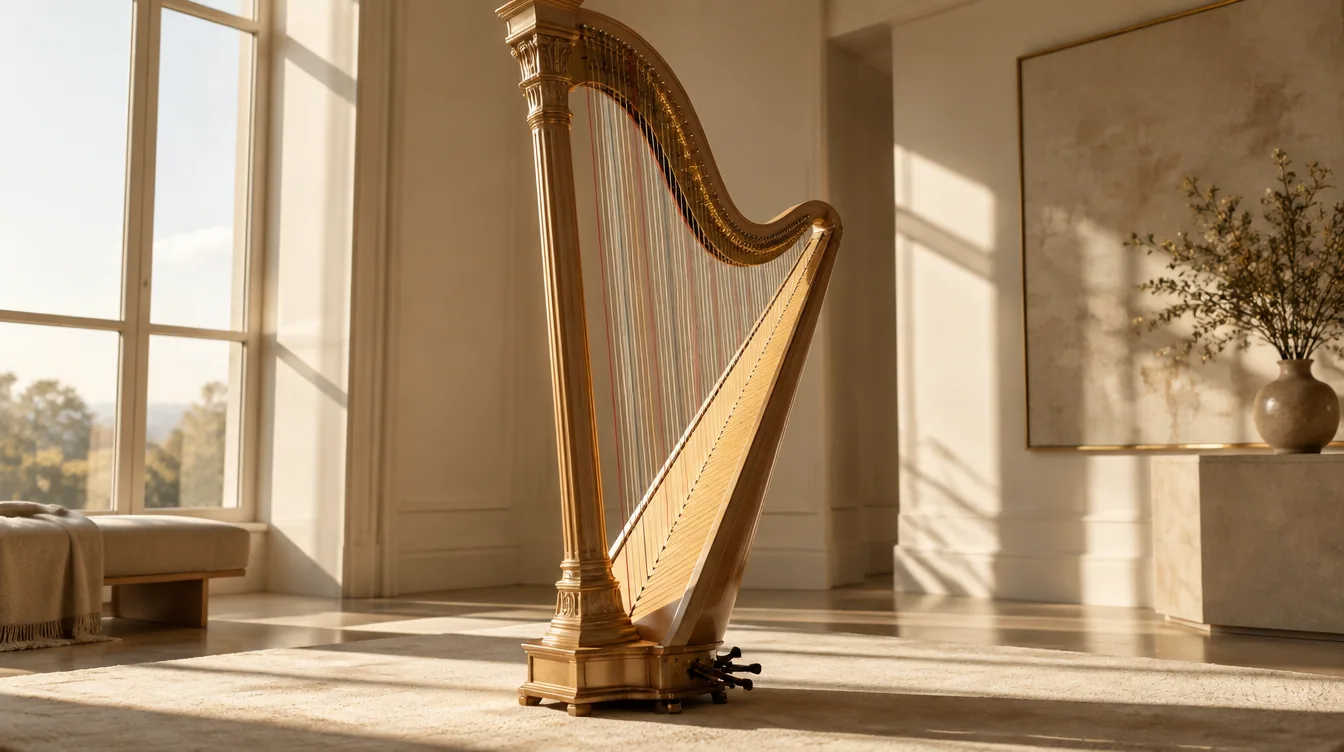
Stand beside a concert harp and the first surprise is the size. It is about as tall as a grown adult, with forty-seven strings running from a curved neck down to a soundboard, and it rests back against the player's shoulder as they play.
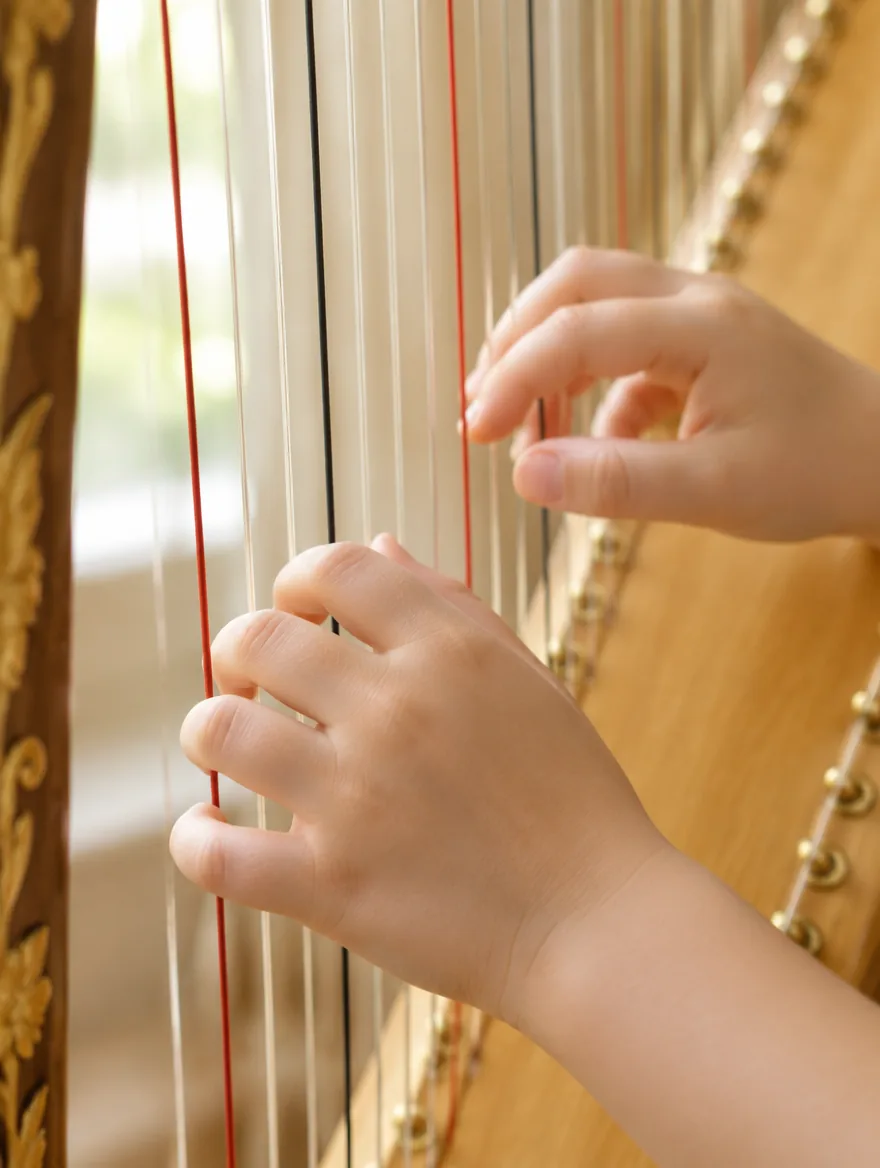
There are no keys, no frets and no picks. The player plucks each string with the pads of the fingers, and both hands work at the same time, much as they do on the piano. A harpist reads the same two staves a pianist reads.
The strings are colour coded. Every C is red and every F is dark, so a player can find their place at a glance, the way a pianist uses the black keys.
At the base of a concert harp sit seven pedals. Each pedal controls one note name across every octave, raising or lowering it by a semitone, and that is how a harp can play in any key. The smaller lever harp does the same job with a little lever at the top of each string. It is lighter, has fewer strings and suits smaller players. Kara teaches both.
It is also one of the oldest instruments in the world. Harps appear in the art of ancient Egypt and Mesopotamia, which makes it strange that so few people here have ever touched one.
Why learn it
Why spend years on an instrument hardly anyone else is learning?
Not because it is fashionable. Because of what it gives a student, and because so few people get the chance.
A complete musical education
Two hands, two clefs, melody and harmony together. A harp student learns to read and to coordinate in full, and those skills carry straight over to piano, voice and anything that comes after.
An ear that listens
Harp strings ring on and fade slowly, and there is nothing to hide behind. Students learn to listen to the shape of a note, to how it dies away, and to the silence between notes.
Music for every occasion
The harp plays classical repertoire, folk tunes, film themes, hymns and arrangements of songs students already love. There is always something worth learning next.
A rare skill, and a distinct voice
In a room of pianists and violinists, the harpist is the only one. That builds a quiet confidence, and it opens doors that a more common instrument does not.
What the harp is not
It is not a quick instrument. The first weeks are quiet, the first pieces are simple, and progress is steady rather than dramatic. The families it suits are the ones who value that pace.
Why Kara
We built the school around the harp.
We did not add a harp to a music school.
Kara has the largest harp faculty in East Java. That matters for a practical reason: a student is never limited to the level of one teacher. There is always somewhere further for them to go, and someone here who can take them there.
A harp is not an instrument you can teach well from a textbook and a spare weekend. Qualified harp teachers are rare in Indonesia, so we have had to develop our own, with a deliberate structure around them.
That structure is what a parent is really paying for, even if they never see it. The teacher in the room has been observed, inducted and developed. The student's progress is written down. Nothing depends on one person's memory or goodwill.
Behind every lesson
A teacher career ladder
Formal observation and induction, so teachers are developed as well as hired.
Semester reports
Your child's progress on paper, so you are never guessing.
A credential portfolio
A running record of each student's achievements, built up over the years.
The progression
A path from the first note to advanced study.
Every harp student at Kara travels the same road. Where a student stands on it depends on how they have developed, and each stage has a teacher suited to it.
How your child is matched
Your rate depends on which teacher your child is matched with, confirmed before you enrol. At the trial we recommend a starting point, and we confirm the teacher and schedule with you in writing before anything is agreed. When the time comes for a move, we talk it through with you first.
Year one
What a beginner's first year actually looks like.
Every child is different, so read this as a shape rather than a timetable.
-
The first weeks: getting comfortable
Learning to sit at the harp, to rest it against the shoulder, and to shape the hand so the finger closes into the string. Finding strings by colour. Making a first clean sound and a first very short tune. Lessons feel more like an introduction than a class.
-
Months two and three: the first melodies
Simple tunes, played from notation, with the second hand beginning to join in. Rhythm and reading start to settle. We ask for a three-month minimum because this is the stretch in which habits form, and habits are what carry a student through.
-
Months four to six: real music
Both hands working together on short but genuine pieces, with attention to dynamics and tone. Semester reports put progress on paper, so you can see what has changed.
-
Months seven to twelve: a small repertoire
A handful of pieces the student knows well, and the confidence to play them for others. Some students are ready to be considered for a move to senior faculty. Others benefit from a longer stay with their first teacher, and that is a decision made on progress, not on the calendar.
 30 min
once
a week
An honest question
Does our family need a harp at home?
It is the first thing most parents ask, and it deserves a straight answer.
A student progresses fastest with regular access to a harp between lessons. That is simply true of every instrument, and the harp is no exception. It is also true that almost no family begins with a harp in the house, and that nobody should need to buy one before they know whether the harp is right for their child.
At the start
Probably not. The first weeks are about building a relationship with the instrument, and we will help you plan how your child practises. You do not need to decide anything on the day of the trial.
As lessons continue
Yes, in time. A student who plays only once a week will move slowly. The right instrument depends on your child's size and age, the space you have and how far they want to go, so the choice is best made with advice.
A lever harp is smaller and lighter than a concert harp and can live in the corner of a bedroom. A concert harp needs more space. Either kind is sensitive to heat and humidity, so in Surabaya the best place for one is an air-conditioned room.
Please do not buy a harp before your trial.
Come and play one first. Then talk to us about the options, and we will help you choose something that fits your child, your home and your budget.
Who it suits
Children, teenagers and adults.
You do not need to have played anything before. You do need to enjoy a quiet, focused half hour.
Children
The harp suits a child who likes to listen, enjoys detail and can be absorbed in something for half an hour. It rewards patience more than talent, and it can suit children who find louder, faster instruments overwhelming.
Adults
Adults are welcome as complete beginners. Many people want to begin or return to music in a way that is calm and absorbing, and the harp is well suited to it. Progress depends on regular practice, not on age.
When it may not be the right fit
If your child needs quick results, or the household cannot keep to a weekly slot and some regular practice, the harp will frustrate everyone. We would rather say so at the trial than after three months.
Come and sit beside a harp.
Nothing explains the instrument as well as hearing one up close. Book a trial, bring your child, and decide with something real to go on.